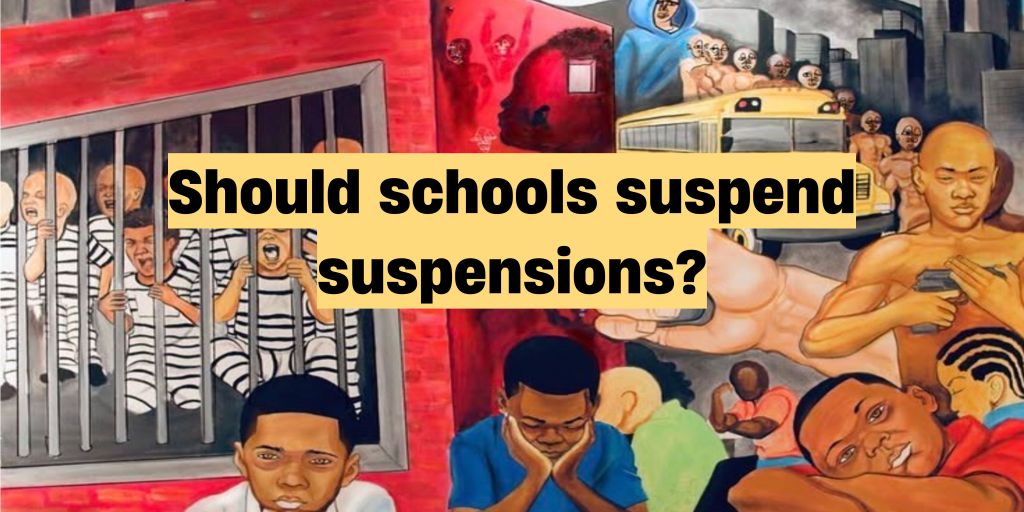
• Should schools suspend suspensions?

    The following pieces were written and submitted by ninth graders for their argument unit in ELA: Should schools suspend suspensions?

    The Harmful Impacts Of School Suspensions by Aleamy Ramirez, B2

                       Although suspensions are the fastest way to punish, it is the worst way to discipline students, because students start to struggle in their classes and criminalize targeted students. 

                      One reason we should suspend suspensions is because many students tend to struggle in their classes. Many students struggle in their classes due to missing the majority of their learning causing them to fall behind. An example from Iztel Luna, “Suspicions in schools are on the rise. But is this the best solution for misbehaving kids?”. She explains harmful reasons caused by suspensions, related on September 12, 2023 from USA today. In the text it states, “These practices are usually not recorded as suspensions, but are all detrimental to child’s learning, said cheryl poe, founder of Advocating 4 Kids.” (par. 3) This means that students with disabilities are losing time to learn and are tending to cause harm. This shows that suspensions are more hurtful than helpful. Schools can’t take away from a child’s learning to punish them.

                     Another reason we should suspend suspensions is because the system criminalizes targeted students. The system has its way to target black and brown students to set them up for failure.  An example from Alex Ortiz, “I’m a student, not a suspect”. She expresses her strong opinions through a speech that was given on June 18, 2020 during a protest to fight for the removal of having NYPD in all schools. Based on the text, “Racist events that I have endured and witnessed range from my friend getting tackled, bruised, and arrested for using a safety pin for his glasses to not being allowed to bring an iced coffee or tea into schools.” (par. 3) This text demonstrates a student getting a physical punishment for bringing a drink into school. This shows how suspensions will negatively impact the safety of our schools. Clearly, the school system seems to unfairly criminalize certain students.

                       However others may argue that if we suspend suspensions violence rates will increase. Some say that suspensions help avoid schools from getting out of control. An example from Education Week, “In defense of suspensions” by Max Eden released on August  4, 2016 compares the perspective of others who think that we should suspend suspensions and his perspective that we shouldn’t suspend suspensions. For instance, “According to the NY State Education Department, the number of violent incidents in schools increased from 12,978 to 15,934 during 2013, de Blasio’s first year in office.” (p.6) This indicates that violence rate increased rapidly when suspensions were reduced. While it is true that the data shows an increase in violent incidents this doesn’t prove that suspending students prevents violence. An increase in reported violence does not mean more violence occurs, it may just mean schools became more aware of incidents to report caused by some sort of violence. Therefore schools should suspend suspensions but they should also be more aware of the root problems that cause students to be suspended. 

                                In conclusion, despite this punitive approach being the fastest way to discipline students, it’s a huge problem as to why we should suspend suspensions. Therefore instead of relying on suspensions, schools should focus on restorative practices and counseling. And take accountability for the racist system that has been built for the wrong reasons. This system will keep hurting students and set students up for failure. 

    Should Schools suspend suspensions? by Roanna Henlon, B4

           The critical question of if “Schools should suspend suspensions?” is a question that gets different opinions and so forth but, imagine walking into school feeling afraid that when you walk into the metal detector it dings even though you know you have nothing on you. Imagine being judged when you walk into school by the police because of your looks.

    Despite others thinking schools should keep suspensions, I disagree with them because not only is there a better way to discipline students and also because using Transformative Justice is a better way to help students.

      Transformative Justice has helped students and even teachers, it gives students a chance to fix damages or harm they caused and learn from it. Source 5 (par3) states “transformative justice also focuses on solutions to harm”. For example after a fight students could meet in a restorative circle to talk about their actions, take responsibility and learn from it. This means that Transformative justice is a better solution for both students and teachers. This will also make the students have a much more different perspective of school.

    Suspensions also contribute to the school to prison pipeline. When students are repeatedly removed from school, they fall behind and disconnect from learning. Over time, this increases the chances of them getting involved with the criminal justice system. This criminalizes students instead of supporting them. Source 3 (par 4) says “The NYPD and DOE work together to make us familiar with the cops, court, and prisons from a young age. That is the school to prison pipeline”. This means that the system is basically setted up for the students to be criminalized and judged wrongfully. Instead of doing that they should try and make the student understand what they did wrong, council and encourage them to be better and learn from their mistakes.

      Some people argue that suspensions are necessary to keep schools safe and teach consequences. They believe removing quote on quote bad students protects others. However, suspensions do not fix the root of the problem and often lead to them even getting worse. More supportive ways hold students accountable while disciplining and keeping them in school.

    In conclusion, schools should suspend suspensions because they increase criminalization  and push students towards the school to prison pipeline. Transformative justice offers a more effective and understanding solutions by keeping students engaged and supported. Schools should focus on helping students grow, not pushing them out. 

    Should we suspend suspensions ?? by Makialee Dubarry, B3

    The debate surrounding whether we should suspend suspensions is a complex one. Ever since students have gotten suspended for unnecessary and regular actions there has been an ongoing debate about suspending suspensions. While some are convinced that suspensions should be suspended, others believe that schools should keep suspensions. Despite all the unnecessary suspensions we should still keep suspensions because certain kids start to bring chaos to school and harm students.

    One reason we should keep suspensions because kids who start chaos need discipline.In the articles I’ve read it shows that well-behaved students are affected. For example in source 2 an informational text it says “the number of violent incidents in school increased from 12,978 to 15,934”. Suspensions being suspended will negatively impact the well-behaved students. This would lead to lessons being interrupted, less work being done. This shows that kids take advantage when punishments aren’t included.

    Others may say that we should suspend suspensions because of all the unnecessary suspensions they give students. In source 1 an informational text she states “ Normal adolescent behaviors, like their tendency to take risk and experiment, is often criminalized for students of color”. Just because a certain race tends to get in trouble more doesn’t mean that it is racism. If suspension was suspended then NYC schools will negatively impact students who come here to learn and make something of themselves. Consider the following data: “the child is still removed from the educational setting”. If the child really cared then they wouldn’t disrupt class time. Children who get suspended are probably already not doing  the work for them to behave like this. Clearly suspensions are needed to keep NYC schools safe and functioning.

    Why does it matter, you may ask. Ultimately, what’s at skate here is students learning and the influence bad behavior has on a student with excellent behavior. You also may wonder what solution you have for the students who have been suspended for unnecessary reasons. One solution I do have for NYC schools is to make suspensions less strict because some suspensions are too harsh, which alienates students. All things considered, suspensions should be kept just so schools can be less distracting and chaos from harming students.

    Schools shouldn’t keep Suspensions by Lisandra Frias, B4

    Schools should suspend suspensions because many students are being disproportionately punished, including those who are neurodivergent or struggling with mental health challenges. Students are often removed from their learning environments for behaviors they may have difficulty controlling, rather than being supported. Although serious misbehavior should be addressed by administrators, teachers shouldn’t automatically take a punitive approach without understanding what the student may be struggling with, outside of school.

    First, schools should suspend suspensions because students are being disproportionately punished.  And according to Ellen Reddy, a fighter against suspensions in Mississippi, in the article of “Suspensions in schools are on the rise. But is that the best solution for misbehaving kids?” By Iztel Luna, published by USA TODAY, Sept. 12, 2023, Ellen Reddy has stated: “They’re still suspending kids for the very same thing — disobedience, talking back, getting out of their seat…We should be asking more questions versus just right away suspending kids.” In other words, a student who acts out in class could be dealing with stress at home, family conflicts, work responsibilities, and or even emotional struggles. Punishment alone doesn’t address the root cause of their behavior and can further harm a student’s academic progress and well-being. Instead of suspensions; schools should focus on understanding students’ circumstances and providing appropriate support.

    Some people might say that suspensions help students behave, but research shows they don’t always work and can actually make things worse. Itzel Luna, author of Suspensions in schools are on the rise. But is that the best solution for misbehaving kids?” published by USA TODAY, (Sept. 12, 2023) explains, “Students of color and those with disabilities are suspended at higher rates than their peers, even for similar behaviors” (para. 5). This shows that suspensions don’t always fix problems and can be unfair. Students also with mental health challenges are also affected, which can make their situations even harder. Instead of punishing students, schools should focus on helping them and understanding why they are acting out, providing support systems that address the root causes of their behavior.

    Suspension & you by Jhanae Delamou, B4

    Despite the possibility of an increase of violence & disorder, suspensions should be suspended because of how they racially or systemically target certain groups of students and how most of the time they are unnecessary & dont even match up to the misbehavior.

    One reason why suspension should be suspended is because of systemic racism &  mistreatment. A student named Alex Ortiz was inspired by the many protests for accountability for Georoges Floyd’s death.  As a Junior of Park Slope Collegiate High school she has witnessed violence & unfair given & endured by her peers. In “I’m a student, not a suspect!” She states, “Racist events I have endured and witnessed range from my friend getting tackled, bruised, and arrested for using safety pins for his glasses…”(paragraph 6) This is a good example of how a student can easily be criminalized for something so innocent as a safety pin. The action of the people involved helped perpetuate the violence toward students of color. 

    It is often argued that violence in school & danger in schools are increasing. And while I do agree with this statement I also must  inquire that there are better methods that can be used before we go to that point. When a student at a high school causes a scene, instead of just using punitive action a different approach was made by the adults which caused a better outcome for the offender, teacher, and those involved. The author states, “And the young man whose words sparked the incident apologized and described how the stress of a difficult morning had boiled over in his behavior.” This is a good example of how restorative justice does more than just lowering suspensions. It helps by using perspective and understanding rather than just punitive force.

    So, for these reasons I have shown why we should suspend suspensions because of the disproportionate system in education & the way it’s used . Despite this argument not being black & white, I ask you to decide and see for yourself. 

    Should We Suspend Suspensions by Joy Sealey, B5

    What if one decision,  a student talking back or a dress code violation, could cut a child’s future earning potential by thousands and triple their chance of being arrested. Although suspensions help address students’ wayward behavior, we should suspend suspensions because there are other alternatives and that it disproportionately impacts Black students, students with disabilities and working class students. 

    One reason why we should suspend suspensions is because there are other alternatives like restorative justice. An example of it comes  from Daisy Yuha’s article called “Restorative justice is more than just reducing suspensions” She released the article on July 25th, 2018 from the Hechinger Report. “And the strong relationships in turn are linked to a greater sense of respect between teacher and student and fewer disciplinary referrals.”(S3, Par.11). This means that restorative justice in schools helps repair harm and relationships instead of other punitive approaches such as suspensions. It should be a worldwide practice for all schools. This form of justice shows that there are other approaches that are more beneficial than giving out suspensions.

    Another reason why we should suspend suspensions is because it  disproportionately impacts Black students, students with disabilities and working class students. An example of this is from Iztel Luna’s article called “Suspensions in schools are on the rise. But is it the best solution for misbehaving kids?” She released the article on September 12, 2023 and it was published by USA Today. “About 25 percent of out-of-school suspensions are given to students with disabilities during 2017-18 school year almost doubling the demographics overall share of student enrollment of 13%” She also claims that “Black students were also disproportionately suspended, only making

    up 15% of student enrollment, but receiving 39% of out-of-school suspension that same year.” This implies that most students that are Black and with disabilities are mostly likely getting suspensions. Disparities like that can lead to low chances for passing classes, or even graduating. This statistical evidence shows that school suspensions disproportionately impacts Black students, students with disabilities and working class students. 

    In conclusion, although suspensions help fix students’ behavior, we should suspend suspensions because there are other alternatives and that it disproportionately impacts Black students, students with disabilities and working class students. Others may say that schools should not suspend suspensions because it would worsen student behavior.The entire discussion that schools suspensions being the easiest way to improve students behavior is besides the point. Instead we should be talking about how schools suspensions can affect students learning time.

    Should schools suspend suspensions? by Derek Peralta, B5

    Although students lose learning time when they are suspended, suspensions shouldn’t get suspended because it reduces school incidents and makes other students feel safe.

     One reason why suspensions shouldn’t get suspended is that it reduces school incidents. In the article titled “In defense of suspensions” by Max Eden explains “former mayor Bill de Blasio began reducing suspensions, the number of violent incidents in schools increased from 12,978 to 15,934 in 2013. This detail from source 2 paragraph 6 explains why reducing suspensions is not a good idea since it’s more likely to cause even more incidents which is the opposite of what they want. In other words suspending suspensions will not work out and will most likely cause more incidents. 

    Some may say that suspending suspensions is a great idea since kids lose learning time when they are suspended at home. In the article “Suspensions in schools are on the rise. But is that the best solution for misbehaving kids?” by Iztel Luna explains “Experts have also expressed concern over what they call “soft suspensions,” which can include practices such as forcing children to spend time in seclusion rooms…These practices are usually not recorded as suspensions, but are all detrimental to a child’s learning” We see this detail in source 1 par. 6. This detail basically states that there is no need for suspensions and instead doing something less harmful. Doing this will not give the kid any guilt to themselves for doing something wrong. Nevertheless, Not giving suspensions to kids in school who do wrong isn’t a good idea and it will more likely backfire since they won’t learn how to behave.

  • The Current is a Monday morning news show from the BILA Wave. This episode covers the week of March 30 – April 1.

    Visit us at bilawave.com or join us on Thursdays after school in C233.

  • BILA Community Persevered to Enjoy Movie Night

    By Khamani Mitchell & Tyrone Beckford, with reporting by Elijah Canton

    On November 20, BILA had its first movie night this year in the library, held by librarian Ms. Davis for community bonding.

    But it would be interrupted by an unannounced evacuation drill. Students who exited the building to get their phones stood outside for thirty minutes.

    Ninth grader Matthew Exea said that he wasn’t impacted by the evacuation drill. “It shouldn’t have been delayed because it was planned in advance,” he said.

    However, about thirty students and staff still gathered for the movie night.

    We asked students and staff why they showed up even with the unplanned evacuation drill. Ninth grader Armani Henlon said, “I just came here to watch a movie and have some fun.”

    Ms. Sanon, BILA’s speech teacher and the Young Royalty Step Team coach said, “Well, what brings me here is to support my colleagues. Definitely to support the students who want to be in the movie night. I love being involved in the school.”

    The next movie night on Friday, December 19 will be holiday themed to celebrate the holiday season. The cost of the movie night is two dollars which comes with refreshments and popcorn. The movie night will start at 2:30 and end at 4:30.

    The school will watch Home Alone, a movie about Kevin McCallister, a kid who was left home alone, leading to him having to take down two burglars who were robbing his parents home while they attempted to return home to Kevin.

    There was a vote for which movie was going to be watched, here are some of the honorable mentions made by students and staff.

    Ms. Sanon said, “I would pick something lively, maybe Home Alone,” following up with “maybe even the Grinch.”

    Tyller Mullings, a tenth grader, said that he wanted to watch Nightmare Before Christmas.

    Not every student wanted to watch a Christmas-themed movie. Tenth grader Jean Bazelais said, “It would be World War Z or The Conjuring.”

  • Staff Spotlight: Mr. Sweeney

    Reporting by Tyrone Beckford, Aaron Dixon, Lisandra Frias, Elijah Canton, and Marshanette Brown

    What’s your name and what’s your position here at BILA?

    Mr. Sweeney. I’m a Global History teacher at BILA. I teach half the tenth graders.

    What are the top 3 things students/teachers bicker about?

    Bathroom, giving students enough notice on assignments, and eating in class.

    What’s your favorite cuisine?

    That’s a hard question. It’s gotta be a Manhattan slice of pizza. When my friends who aren’t from New York come here, I rub it in every time.

    What’s a hidden gem activity or experience at school that more people should appreciate?

    We take for granted how awesome our Library is. It’s crazy a lot of students don’t get to use it – only during lunch or not at all. We have an awesome librarian – many schools don’t have as good of a library, or have one at all.

    What do you consider iconic?

    Every song by Queen.

    What’s your impression of every grade?

    I have a ninth grade advisory, and I’d consider them positively energetic. Tenth grade is diligent. Eleventh grade is outspoken. The seniors are self-directed, self-managing, and self-controlled.

    What’s your go-to song?

    “Love Remembered.” It’s a song from the original Dracula movie. I probably listened to it 2,000 times last year. It’s all about love forsaken.

    If you could be doing anything else right now, what would you be doing?

    I’d be somewhere warm by the water with a book.

  • A Team Worth Fighting for: The Wingate Generals Baseball Team

    by Abraham Nerius

    Just last season the Wingate Generals baseball team was barely active and struggled to stay together. But thanks to the effort of a few students and staff, the team is back.

    This story looks at how close Wingate baseball came to being shut down and how a new group of players, coaches, and supporters are working hard to keep the team alive and build something stronger for the future.

    Mr. Corrado, who stepped in as coach, recalled how close the team came to being shut down entirely. “Last year, there wasn’t even a team. To the PSAL, it looked like the school didn’t care about the sport.” That impression almost cost them everything. Due to a scheduling conflict with a school trip to Washington D.C., players were absent, and Corrado had to spend two days on the phone with the PSAL commissioner just to convince him to let the team continue. “I had to be the one to save it.”

    Following that, BILA’s administration backed the effort with resources. BILA Principal Ms. Henry-Stephens said,“We provided whatever resources they needed equipment, uniform and staff. We paid for Mr. O’garro to be the assistant coach.” She said she just hopes to see “a winning team!”

    Junior David Perez, who plays pitcher, catcher, and shortstop, embodies the heart of the team. “The coaches are good, even if we lose games, he’s positive about it … If [the team] was gone, I would be sad because I enjoy baseball, even though it wasn’t my first sport. It’s really fun.” Like many of his teammates, David sees this season as a beginning. “It’s everyone’s first time, so next year we should be a better team.”

    Also for Junior Tristen Scott, joining the team wasn’t even about the sport itself. “I’m not into baseball, but I saw the team needed help,” he said. “Coach motivates me to do better and wants me to try hard every game. I hope the team can reach the playoffs someday.” His willingness to contribute, despite not really liking baseball, reflects the spirit forming around the team.

    Team manager and junior Deyaniri Gomez also has a personal reason for being involved in the team. “I wanted to be a part of the team as a player but couldn’t because I’m a girl, so I became the manager,” she was also concerned for the state of the baseball team as a whole.“I was really scared the team was going to be disbanded. I genuinely wanted a baseball team.” When asked how the team can improve, she wasted no time: “If the players went to practice and took it more seriously, they would win. The coach needs to be harder on the players.”

    “I always liked coaching,” said Mr. Corrado. “The goal is for the team to be competitive and fun to be on. The players are good; the only problem is experience. No coach can just take over a team and make them great in a flash.” 

    He’s still encouraged by their progress though. “They’ve gotten so much better in a short span, so imagine what they can do in a few years.” He credits several people for assisting him in coaching: Cutaneo who is an experienced player and helps Mr. Corrado with drills along with coaching in general things Abdul and O’garro who help with coaching on the field. Mr. Corrado describes it as a sort of good cop bad cop situation.

    BILA’s baseball team is still a work in progress. But behind every practice, there’s a group of students and staff who refuse to let the team disappear and who are determined to make it thrive.

  • Eid Al-Fitr’s Postponement Brings Mixed Reactions Within BILA Community

    By Keiera Calderón

    From the evening of March 29 to March 30, Eid al-Fitr, which literally means ‘festival of breaking the fast’, is an annual Muslim festival celebrated by our BILA Muslim community, marking the end to Ramadan – a month-long period of fasting. Muslims worldwide gather with family and friends to exchange gifts, feast, and partake in a day of renewal and gratitude.

    During Ramadan, vital members of our school community who belong to the Muslim faith go on a journey of spiritual reflection. This includes fasting, abstaining from certain activities and willingly sacrificing their meal times during hours of sunlight to grow closer to God and empathize with the less fortunate. Despite these challenges, they continue to show up to school each day, putting their best foot forward. Their dedication and resilience deserve our recognition and respect.

    What Transpired

    The Student Council put together an event to celebrate Eid with our Muslim-faithed community, which was scheduled on April 10 after school, the Friday before Spring Break. This thoughtfully planned gathering would have inevitably sent the school community off with new connections, deeper understandings and – above all – joy and togetherness.

    “I think it’s a great opportunity to bring all students together to share food, make memories, and it’s a moment of joy and recognition for students who mostly go unnoticed. Most of these events were attended by non-Muslim students who came to support,” said Ms. Nahar, ninth grade English teacher and co-advisor of Student Council.

    This event was designed to give us a deeper grasp on what Eid means to our Mmuslim peers. 

    A student celebrating Eid in the 2019 celebration

    According to Marionette Augute, member of Student Council, “Eid is practically to represent those who are Muslim, to just educate people on what’s occurring within the Muslim community. Eid actually started in 2019 here in BILA.  And ever since then, Eid is meant to be an event to  welcome those who are Muslim and show them that you are seen in BILA.”

    However, the event was abruptly cancelled due to religious imbalance. 

    Ms. Nahar and Ms. Bhehaspat at the 2024 Eid celebration

    In an email to the Student Council advisors, administration wrote, “In order to be equitable to all of our stakeholders, we will postpone the Eid celebration until we can plan an interfaith celebration. … This can be a learning opportunity for the whole community. Or, we will not have any celebration at all.”

    Easter, which takes place on Sunday, April 20th, a religious holiday celebrated by our larger Christian population, falls fairly closely to Spring Break. Administration felt as though that it wasn’t given as much recognition as Eid was being given, and that if one religious event was being celebrated then the other should too. It was a both or none situation. 

    Many community members felt as though this approach was unwarranted and unfair to our minority Muslim population within a predominantly Christian community. They believed that, as a minority group, Muslim students should be given the opportunity to express their culture and educate others about practices that they may be unfamiliar with.

    Reactions to the Cancellation 

    Some staff and students sensed that their voices and beliefs were being suppressed, fueled by growing anti-Islamic prejudice growing in the political climate, and spoke out against it.

    This decision mostly affects our Muslim population and it is their right to be represented as part of our diverse school culture. “I feel very sad because it was supposed to represent my culture and they just cancelled it. I was so excited to go to it. And I’m so disappointed by the admin’s decision,” an eleventh-grade member of our Muslim community, Asarar Suhail, adds.

    A collage of students and staff celebrating Eid

    Mr. Mohamed, who is one of our Muslim mathematics and history teachers, expressed his discontent by saying, “I heard about the change, and it immediately reminded me of the ‘All Lives Matter’ response to Black Lives Matter—a refusal to give marginalized voices space without centering the majority. Postponing the school’s Eid event for Easter feels like a quieter version of that…From what I understand, the Eid celebration has been held for years, so it’s hard not to view this as a reflection of today’s broader political climate where even basic recognition of underrepresented communities is framed as exclusionary.”

    “Ms. Ali and I were surprised at this last minute change because it had already been approved. And this is an event that has been anticipated and requested by students every year,” says Ms. Nahar. “This is the first year that it has been pushed back. We have been celebrating it since 2019.” 

    Kashawn Wright, a tenth-grade student who is not familiar with Eid al-Fitr and is new to BILA from the SHR merge, explained, “I don’t really know what it is since I’m not Muslim but I wish I had the chance to go so I could be educated on it…I wanted to eat with some of my Muslim friends.”

    Students like him were meant to be enlightened on the holiday, and to be part of intercultural exchange efforts, but are unable to due to the unexpected circumstances.

    “I was really looking forward to doing some henna. That’s so unfortunate,” another student remarked.

    2019 Eid celebration

    The Student Council was called “narrow minded” for not including the other celebrations as part of the event.

    Auguste adds on, “Many people believed that it being postponed just to collaborate it with Easter celebration was not unfair, but … more unneeded.”

    “I think that it’s unfair that the decision to have a joint celebration wasn’t brought up before approval was given to do the Eid celebration. I do think it would be better to celebrate all the cultures that are experiencing holidays at the same time with a joint celebration because it could be a nice way for others to learn about other cultures,” said Ms. O’Mealley, a Global History teacher who taught at School for Human Rights last year. “But since the Eid celebration had already been sanctioned, why wasn’t that thought made then? Because we knew that Easter was coming up, we also knew Passover was coming up; all of it could’ve been together so that students and staff could’ve had a larger, more interconnected event and for all of it to be postponed last minute feels like a mean thing to do, in general.” 

    At the time of printing, The BILA Wave was unable to receive a comment from administration. The article will be updated to reflect any statements from administration on the online version of this article at bilawave.com.
    Though Eid’s postponement may have caused great discouragement for many, the silver lining is that students and staff have more time to plan out the event.

  • Balancing Parenthood and Purpose: Mr. Hunt’s Welcomes His Second Son

    By Abraham Nerius

    On February 2, Brooklyn Institute for Liberal Arts’ (BILA) Assistant Principal Mr. Hunt and his family welcomed a new baby boy. As Mr. Hunt navigates his second journey into parenthood, he shares the joys, challenges, and life lessons that come with raising two children. From the pressure of raising a son to the importance of setting boundaries with technology, his experience offers valuable insight for both new parents.

    When asked about how becoming a parent again differs from his first experience, Mr. Hunt shared that it’s easier this time around, as having another child, especially another son, shifts his priorities. He explained that his focus has moved from being self-centered to ensuring his household, particularly his children, are taken care of. “You become less self-involved when you have someone else to care for,” he adds. 

    The arrival of his second son has also made him more aware of the pressures of fatherhood, particularly the responsibility to raise his sons to be good men. With two boys now, he feels the need to be even more vigilant and thoughtful in his approach to parenting. Mr. Hunt admits that during his first experience with fatherhood, he felt nervous and uncertain, confessing, “I did not enjoy having a baby the first time.” 

    However, as a parent who already has the experience he finds himself enjoying fatherhood more. “I’m not nervous this time,” he shares, that he enjoys this baby more than he did his first son when he was a baby. He says he feels more comfortable now because of all the practice and experience he’s gotten, explaining, “I think bonding with the baby happens a little later with the father. The first time, there wasn’t much bonding, but this time, I enjoyed the process more.” He says, “Don’t tell my first son that!”

    Having experienced parenting a newborn twice, Mr. Hunt offers practical advice for future parents. His message is simple: “Have fun,” he believes the world is a big, wonderful place for children to explore. He encourages parents to let their children experience some hurt, it’s an essential part of learning. Mr. Hunt also advocates for a minimalist approach to baby products, suggesting that parents don’t need as much as they’re often told.

    Additionally, he is passionate about limiting screen time for children, “I think it’s irresponsible for parents to expose their children to smartphones and social media.” He plans to keep his sons’ childhoods “phone-free” for as long as possible, emphasizing that he wants them to play, read, and interact with friends in person, believing phones can wait until they’re at least 14. The most rewarding part of parenthood is watching his children grow and develop. While he hasn’t yet seen much of himself in his sons, he hopes to avoid passing on his mistakes, “You have kids in part to correct the mistakes you made.” 

    Becoming a father has also strengthened his relationship with his wife, as he shares, “We’re closer than we’ve ever been before,” recognizing the challenges and joys of raising children together. 

    To end it off,  Mr. Hunt offers some words of wisdom to the children of BILA that he loves so much: 

    “Put your phone down.”

  • Trans Day of Visibility

    By The BILA Wave

    This year, we will celebrate the 16th annual Transgender Day of Visibility (TDOV) on March 31, 2025. This TDOV comes in the midst of attacks on trans rights by the Trump administration.

    Transgender Day of Visibility came to be on March 31, 2009, due to the fact that there weren’t many days which recognized the trans community with the exception of Transgender Day of Remembrance (TDOR). TDOR is a day that celebrates the life of transgender people who were unfortunate victims of violent transphobia. This day was made because an African American transgender woman, Rita Hester, 34, from Hartford, Connecticut was murdered. 

    In Boston, Massachusetts, there is a mural for Hester called Rita’s Spotlight, which was created by a Latinx Caribbean artist Rixy. 

    Rita Hester was neither the first nor the last trans person to be harmed by transphobia, and today there are still many Trans people who are harmed and/or killed each day. A more recent example is the story of Nex Benedict, a transgender teen who tragically passed away after being attacked in their school’s bathroom. 

    The only way to stop this violence is for people from every community to come together, not just the trans community. 

    However, transgender people wanted a day to be heard and to be proud of their identities, not just a day to mourn. So, Rachel Crandall Crocker, a transgender activist founded Transgender Day of Visibility.

    When a student here at BILA,  Shayla (they/them, tenth grade) was asked about the gender binary, they said: “I think that I’m in between. I think differently. Nothing should have a gender label put on it.”

    What Does Being Transgender Mean?

    In this section, we’ll discuss several identities that fall under the umbrella term transgender, and discuss some of the different pronouns (she/he/they/other) that they may use. If you don’t know someone’s pronouns, just ask!

    Transgender

    The majority of people are cisgender, which means your gender identity matches the sex you were given at birth. In other words, if you are cis, you were born a female and you identify as a girl or woman (usually using she/her pronouns), or you were born a male and you identify as a boy or man (usually using he/him pronouns). When somebody identifies as transgender, that means that their gender identity is different from the one they were assigned at birth. Some transgender people may receive medical assistance to medically transition from one sex to another, this is known as transexual, but many prefer to simply identify as transgender.

    Nonbinary

    When someone identifies as nonbinary , they don’t identify with the male or female binary. Typically nonbinary folk use different pronouns than most people, an example of the pronouns you might see nonbinary folk use is the pronouns they/them/theirs. Some may even use neopronouns, like ze/hir/hirs, which are pronouns that are different common pronouns such as she/her/hers or he/him/his.

    Intersex & Intergender

    Intersex and intergender individuals typically happen to be similar, however they’re not quite the same.

    What Issues Do Trans Folks Face?

    According to the Human Rights Campaign (HRC), trans folks face higher rates of poverty, lack of healthcare coverage, lack of legal protection, inaccurate identity documents, and stigma, harassment, and discrimination. Trans people experience violence at rates far above their cisgender counterparts. According to the HRC, “Over a majority (54%) of trans people have experienced some form of intimate partner violence, 47% have been sexually assaulted in their lifetime and nearly one in ten were physically assaulted in between 2014 and 2015.” These statistics are only a brief look at the tragedies faced by transgenders, which is exactly why TDOV is so important. TDOV allows transgenders to have the attention and support they need from their communities. 

    How We Can Celebrate Trans Visibility Day

    There are many different ways to celebrate or honor any holiday, but TDOV is a day focused on celebrating trans pride, which some people may not know how to do. Below are several examples of how to celebrate and enjoy TDOV.

    • Art: Despite all the actions taken to highlight transgender’s talents, many hard working artists go unnoticed due to constant transphobia. Thankfully Mushroomy is combating this transphobia by highlighting trans artists as well as original artwork by transgender artists.
    • Music: TDOV gives us a chance to put trans musicians in the spotlight. If you’re into broadening your musical horizons check out Billboard’s article about current transgender and nonbinary musicians.
    • Protest/Marches: To celebrate TDOV a trans owned non profit organization, NYC Youth For Trans Rights, organized a march that will take place on March 31st in Union Square Park, Manhattan.  

    Issues Faced by Trans Youth

    Many young trans people, especially students, may face bullying or harassment. Health Partners, in an article, about transgender mental health, wrote, “Many trans people have one or more mental health disorders.” Of these mental health disorders, trans youth are largely impacted by anxiety. This is sadly because of the harsh treatment they are likely to receive at school, and even at home and while all trans youth face these issues, trans youth of color are disproportionately affected by these problems. TDOV seeks to give these youth a day where they are appreciated rather than shamed. 

    Famous Trans Celebrities & Historical Figures

    There are plenty of famous trans people but not everyone is aware of that due to the lack of coverage that the trans community receives. Here’s a list of ten distinctive famous and historical transgenders . 

    Resources for LGBTQ+ Students

    This section is for any LGBTQ youth seeking help with shelter or mental health issues. It can be hard to find help in your community, that’s what BIlA Wave is trying to change with this article.

    1-866-488-7386 to speak with a trained counselor at The Trevor Project. The Trevor Project is a suicide prevention hotline devoted to LGBTQ youth.

    1-800-273-8255 to speak with the National Suicide Prevention Lifeline. The National Suicide Prevention Lifeline connects people in crisis to counselors, free of charge, across the United States. 

    1-800-273-8255 to speak with a counselor from the American Foundation for Suicide Prevention. The American Foundation for Suicide Prevention provides resources and research to prevent suicide.

    Can also text HOME to 741741 to connect with a Crisis Text Line counselor via text message. If needed, there are more resources at Resources for LGBTQ Youth

    If you have run away, or are considering running away, consider reaching out to the resources below:

    • OCFS oversees Runaway and Homeless Youth Shelters in New York State.
    • The National Runaway Safeline for confidential and affirming support: 800-786-2929. They also offer text and email support, and a forum for peer discussion.
    • The Ali Forney Center is dedicated to housing LGBTQ runaway and/or homeless youth. The Ali Forney Center serves youth ages 16-24 in New York City.

    Pride for Youth provides services and advocates for LGBTQ youth in Queens, Nassau, and Suffolk counties.

  • The Wellness Room: BILA’s Very Own Comfort Zone

    By Keiera Calderon

    Ever had a bad day where you felt all odds were against you and you had no one to talk to? Well say no more! Visit the Wellness Room! A wonderful place — a judgement free zone — where you can pour out your feelings and share your thoughts, our social workers there to guide and understand you every step of the way, showing that they care.

    Why is mental health so important?

    Day by day, we notice that young teens — our peers and acquaintances — are battling mental health issues by themselves. The rates of teens suffering from anxiety, depression, and other mental health issues are sky-rocketing, becoming more frequent than we’d like to admit. Shockingly a whopping 50% of all lifetime mental illnesses begin at age 14! Beyond that 42% of teens experience persistent feelings of sadness or hopelessness, and 22% of teens have seriously considered attempting suicide, according to the Compass Health Center. Nobody should have to endure these tribulations on their own, there should always be a helping hand that you can rely on, whether that be in your school community or at home.

    BILA’s Contribution

    Just this year, Brooklyn Institute for Liberal Arts established a room specifically for students to freely express themselves and seek comfort. You may have seen this room as you pass by on your way to class, with our two social workers sitting at their seats or mediating with a student. Many school staff i.e teachers, admin, support staff, have limited knowledge about how to support students’ mental health; that’s where local school social workers come in and act as conduits between community mental health foundations and willing students.

    As reported by the UCLA Center for Transformation of Schools, “A wellness space provides students with a physical space to focus on self-care, develop healthy coping habits, and reduce their levels of anxiety and stress.” Having this outlet at our school has the potential of helping many students get the help they need.

    Ms. Teclai, aka Ms. Tec, is our very own social worker. Ms. Tec, says, “BILA’s Wellness Room is a place where we’re able to speak with students regarding their social-emotional issues. Anything relative to their mental health. Or they can use this space as a way to emotionally regulate or regulate their moods. If there’s any time that they’re feeling angry, upset, or they feel overwhelmed, they can use this space.”

    Who Will You Expect to Meet There?

    You may see your friends, classmates, random schoolmates, and other teachers coming by here-and-there, but the main faces will be our social workers. They conduct boy and girl groups on separate days during the week; and private sessions when a student just needs to vent.

    There, you can find Ms. Tec, whose official job title is a social work supervisor and site manager. You can find her at her seat, either deep in conversation with a student or with a cheery smile whilst talking to her colleague, Ms. Vincent.

    In addition, Ms. Vincent is our social work intern and she’s here with us on Mondays and Wednesdays, always looking forward to getting to know her students. She’s also usually conducting private sessions with students or engaging in conversation with Ms. Teclai.

    You might be rushing to class when you catch sight of one of the social workers sitting opposite to a student, looking very serious with the door closed. That’s how you know it’s a private session and it’s rude to intrude.

    Ms. Tec explained, “We give them some space. We ask them if they would like to talk to one of us and then when they do agree to talk to one of us, we ask if both of us can be present. If not, the other person leaves the room and we’re able to have more personal conversations with the students about what it is that’s bothering them.”

    What To Know !

    Located in Room C231, the Wellness Room is an open space where all students are welcome. Ms. Tec elaborates on this saying that, “It is on the second floor. It’s the room with all the comfy couches inside of it, so you can’t miss it.”

    At lunch, groups are held where students as a collective can come together and express themselves. “We also hold groups. Groups, but based off of peer-mentoring, which is a place for students to learn about mediation, and being a mentor. There’s groups like girls groups. We’re separating them because students have different lunches, and then boy groups as well,” Ms. Tec unravels.

    Ms. Tec adds on, “If you are feeling unwell and you need a space, then we’re here; we’re present. Ms. Vincent is here on Mondays and Wednesdays, and I’m here all days of the week. So…and of course Ms. Philip is here all days of the week as well.”

    One student, Allison Dodard (B9), supports this by saying, “When I think about the wellness room, I feel like it’s a safe place to be and you can talk about how you feel. You can tell people about you or how you feel about the school, and if you’re in a bad mood or you wanna let your emotions out, the wellness room is the right place to do that.”

  • BILA’s “Suburban Dad”: A Bio

    by Abraham Nerius

    This week, The BILA Wave sat down with Mr. Pfaeffle, our dedicated Biomedical Science teacher, who has been shaping minds at BILA for nearly a decade.

    Reflecting on his journey to teaching, Mr. Pfaeffle shared how he wasn’t always the ideal student. In high school, he focused more on sports than academics and took an unconventional path by attending community college and working full-time. 

    Over time, he discovered a passion for learning and decided to pursue a career in education. Choosing biology for its flexibility, he realized he could make a meaningful impact on students’ futures.

    When asked about the most rewarding part of teaching Biomed, Mr. Pfaeffle lit up. “When I hear, ‘Oh, oh, oh!” that sound of students getting it – I love it,” he said. He describes himself as a “facilitator,” helping students find solutions independently. 

    For him, the biggest takeaway isn’t just science content, but life skills. He hopes students leave his class better prepared for their futures, equipped with problem-solving skills, self-agency, and the confidence to tackle challenges.

    Outside the classroom, Mr. Pfaeffle describes himself as a “suburban dad,” balancing teaching with family life and DIY home projects. From building decks to planting shrubs, he’s constantly learning new skills just like he encourages his students to do. 

    His parting advice to BILA seniors? “Be nice and work hard.” Wise words from a teacher who truly leads by example.